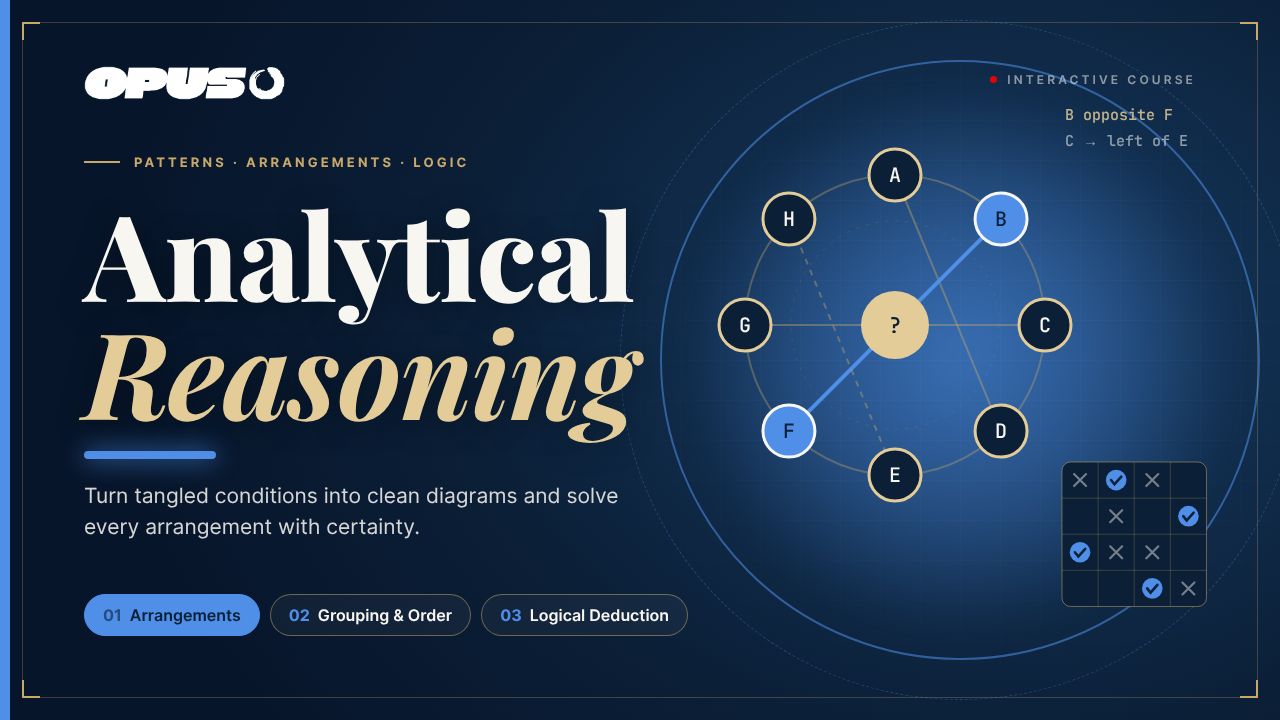
Analytical Reasoning
Course Summary
Turn rules into a diagram and answer the questions from it: grouping, ordering and hybrid set-ups, conditional rules, and every question type that follows.
What's in the course (1st lesson always FREE)
- Translate a set of rules into one master diagram, with a notation that stays readable under time pressure.
- Tell ordering rules from grouping rules and see immediately what each one fixes.
- Write contrapositives correctly and use them to place entities you would otherwise guess at.
- Answer must-be-true, could-be-true and complete-and-accurate questions from the diagram rather than by trial.
- Handle a conditional question with a small redraw instead of rebuilding the game.
- Recognise a hybrid game and choose a diagram that serves both halves of it.
The Course Architecture
What's inside.
Analytical reasoning is won in the set-up. The course teaches a notation and a routine: list the entities, fix the positions, write the rules in one place, and derive what the rules place before you read a single question. Every game type is covered - ordering, grouping and the hybrid set-ups that mix both - with conditional rules and their contrapositives treated as tools rather than as formal definitions.
Then the questions, which are a smaller set than they look: what must be true, what could be true, what cannot be true, a complete and accurate list, and the conditional question that adds one rule for one question only. Each is answered from the master diagram, or from a small redraw of it, never by trial and error.
How to use it.
Learn the diagram conventions first and keep them identical every time; the value of a notation is that you stop thinking about how to write and start thinking about what the rules allow. Do the worked games with the answer covered. When you miss a question, decide whether the diagram was wrong or the question-reading was, because the fix is different.
What students get.
A single diagram notation, built to stay readable under time pressure
Conditional logic for games, including contrapositives and what they place
Worked games of every family, solved from set-up to answer
Question-type drills, so the wording tells you the move
Timing guidance on the set-up, where games are usually lost
A progress panel that tracks what is finished and what still needs work
Learning Outcomes
- The full set-up method - entities, positions, rules, and the diagram conventions that keep them straight.
- Conditional logic for games - contrapositives and what they place.
- Worked games of each family, solved on screen from set-up to answer.
- Question-type drills - must be true, could be true, cannot be true, complete and accurate, and the conditional question.
- Timing guidance: how long a set-up may take before the questions stop paying.
- A progress panel that tracks what is finished and what still needs work.